
Brooklyn vs Manhattan Street Style Differences in 2026
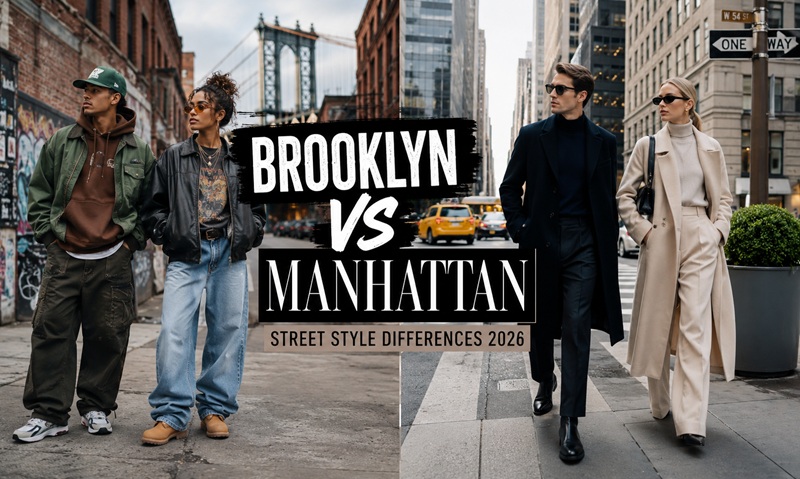
Ask a Williamsburg local and a Midtown regular to describe NYC street style, and you’ll get two very different answers — and both will be right. The Brooklyn vs Manhattan street style divide has always reflected something bigger than fashion: different values, different relationships with trend cycles, different reasons for being in New York. In 2026, those differences have sharpened.
Why the Brooklyn–Manhattan Style Divide Still Exists
It’s tempting to say the internet flattened everything — that Instagram made street style homogeneous across boroughs. That’s only partially true. What’s happened instead is that each borough has doubled down on its identity as a counterpoint to the other.
Manhattan got more intentionally polished. Brooklyn got more intentionally low-key. The people who moved between both got more creative.
Manhattan Street Style in 2026: What It Looks Like Now
Manhattan style in 2026 skews toward structured, deliberate, and increasingly expensive-looking. This isn’t new, but the specifics have shifted.
Key elements:
- Tailoring is back in full force — blazers with wide lapels, pleated trousers, structured shoulders
- The “quiet luxury” aesthetic has legs — neutral palettes, recognizable-only-to-those-who-know branding, emphasis on fabric quality over logos
- Footwear: leather loafers, kitten heels, and sleek minimalist boots dominate below 34th Street
- SoHo and the West Village lean into an international editorial sensibility — people who dress as if they’ve just landed from a European fashion week
- Upper East Side maintains a classic American preppy base with updated proportions
The Manhattan dresser in 2026 is doing more with restraint. The statement is often in a single detail — a coat fabric, a precise trouser break, a bag that’s understated but clearly not cheap.
Brooklyn Street Style in 2026: The Current Look
Brooklyn in 2026 is doing something different — and arguably more interesting to watch.
Key elements:
- Workwear and utilitarian pieces remain strong: Carhartt, Dickies, and purpose-built canvas jackets worn as fashion
- Vintage-heavy wardrobes — Williamsburg and Bushwick wardrobes are built around thrift stores and vintage markets rather than retail
- The silhouette is baggier — wide-leg pants, oversized tops, deliberately oversized denim
- Mixing high and low is more radical in Brooklyn; a $400 sneaker with a $12 thrifted work shirt reads as a coherent outfit
- Subculture signaling is more visible: skate references, music scene markers, art world adjacency all show up in how people dress
Brooklyn style tends to read as more personal and less about legibility to outsiders. If Manhattan dressing communicates status or profession, Brooklyn dressing communicates scene and sensibility.
Side-by-Side Comparison
| Manhattan 2026 | Brooklyn 2026 | |
|---|---|---|
| Dominant aesthetic | Quiet luxury, tailored, editorial | Vintage, utilitarian, eclectic |
| Color palette | Neutrals, earth tones, monochrome | All of the above + bold contrast |
| Silhouette | Fitted to slightly relaxed | Oversized, baggy, deconstructed |
| Brand visibility | Minimal but intentional | Mixed — vintage logos to no branding |
| Price point signal | Expensive-looking but understated | Deliberately price-agnostic |
| Key pieces | Tailored blazer, loafers, structured bag | Vintage denim, workwear, statement sneakers |
| Footwear | Loafers, kitten heels, clean boots | Sneakers, chunky boots, worn leather |
The Crossover: Who Dresses Both Ways
The most interesting street style in NYC 2026 belongs to the people navigating both worlds — artists with day jobs in creative agencies, designers who commute between studios and client meetings, photographers who shoot in Brooklyn and edit in Manhattan.
Their wardrobes tend to combine:
- One tailored piece (trouser, blazer, structured shoe)
- One relaxed or vintage element
- A deliberate accessory that signals awareness of both codes
This crossover sensibility is arguably the most distinctly “New York” aesthetic of 2026 — not fully committed to either borough’s code, but conversant in both.
Pro Tips: Dressing for Both Boroughs
- A slim black trouser translates across boroughs better than almost anything else
- A quality vintage piece (not a costume — something wearable and worn) reads as credible in Brooklyn without looking out of place on the L train to Manhattan
- Avoid literal borough costuming: wearing head-to-toe what you think “Williamsburg style” looks like usually reads as tourist, not resident
Common Mistakes to Avoid
- Assuming quiet luxury works everywhere — in Brooklyn creative spaces, it can read as out of touch rather than refined
- Assuming Brooklyn style is cheap — some of the most expensive sneakers, vintage pieces, and independent-brand items live in Brooklyn wardrobes
FAQs: NYC Borough Style
Q: Is there a Bronx or Queens street style identity in 2026? Absolutely. The Bronx maintains a distinct sneaker and streetwear culture with its own history; Queens street style, particularly in Flushing and Jackson Heights, reflects international influences often ahead of Manhattan trends.
Q: Does neighborhood within Manhattan matter for style? Significantly. The East Village dresses more like South Brooklyn than it does like the Upper East Side. Downtown Manhattan’s style codes are closer to Williamsburg; Midtown and Uptown are more formal and corporate.
Q: Is Manhattan style really more expensive? Not necessarily in purchase price, but the look of Manhattan style in 2026 — quiet luxury, precise tailoring — signals higher spend even when it’s achieved thoughtfully on a budget.
Conclusion
The Brooklyn vs Manhattan style divide in 2026 isn’t about one being better — it’s about two coherent aesthetic philosophies coexisting in the same city. Manhattan dresses for legibility and refinement; Brooklyn dresses for identity and originality. The most interesting NYC style right now happens when those two things meet.
Know which codes you’re working within, and dress like you mean it.


-
Why Personalized Engagement Rings Add Meaning to Marriage Proposals
A marriage proposal is one of life’s most memorable moments, and the ... -
-
-
-
-
-