
Golconda Diamonds: Colorless Purity and the Rarest Pink and Blue Treasures
Golconda diamonds hold an exalted position in gemological history, recognized as some of the finest diamonds ever discovered. Unearthed from the legendary mines of the Golconda region in present-day Telangana, India, these diamonds set the global benchmark for purity, brilliance, and optical transparency. The majority of Golconda diamonds belong to the coveted Type IIa classification—diamonds formed with almost no nitrogen impurities—resulting in an exceptionally limpid, colorless appearance often described as “whiter than white.”
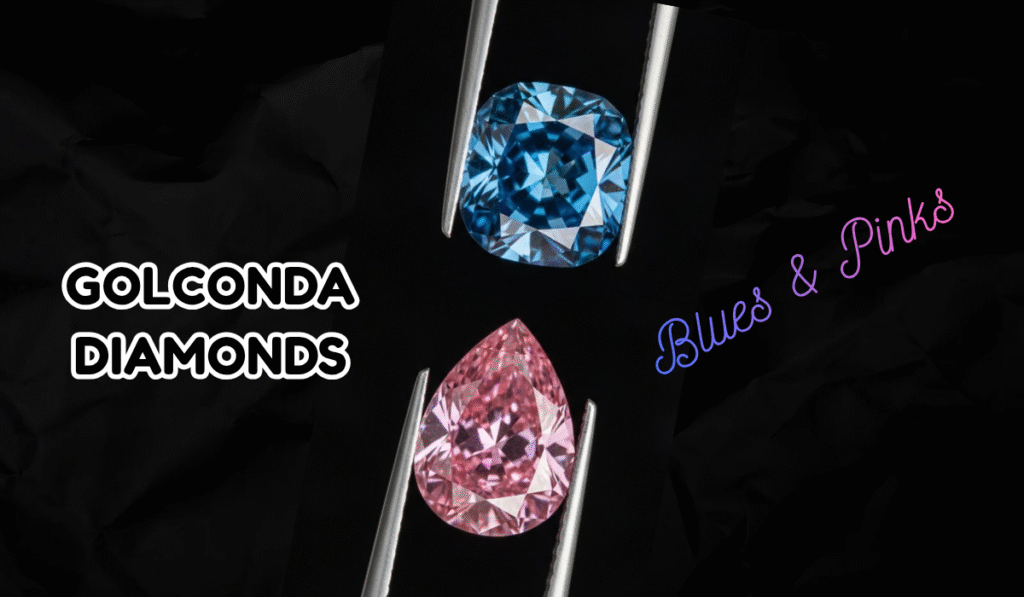
However, despite this reputation for colorless perfection, Golconda mines also produced several remarkable colored diamonds. These rare pink and blue Golconda diamonds stand as extraordinary gems whose hues emerged due to slight and uncommon geological influences during their formation. Their rarity and beauty have given them legendary status in collections, museums, and royal treasuries.
COLORLESS GOLCONDA DIAMONDS
The reason most Golconda diamonds are colorless lies in their formation environment, which lacked nitrogen and other trace elements that usually become embedded within a diamond’s carbon lattice. Nitrogen is the most common impurity in diamonds and is responsible for most yellow or brown coloration seen around the world. Golconda diamonds, however, formed under unique geological conditions where nitrogen was nearly absent.
This resulted in diamonds classified as Type IIa—the purest diamond type known. Type IIa diamonds exhibit exceptional transparency, high brilliance, and a “water-like” appearance that was especially prized by Mughal and later European royalty. Famous stones such as the Koh-i-Noor (105.6 carats in its modern cut) and the Regent Diamond (140.64 carats) exemplify the immaculate colorless quality associated with Golconda gems.
COLORED GOLCONDA DIAMONDS – RARITY
Although Golconda diamonds are best known for their colorless purity, nature occasionally introduced a slight anomaly during formation, resulting in exquisite pink and blue diamonds. These occurrences were extraordinarily rare—so rare that only a handful of historically documented colored diamonds from Golconda exist today.
Unlike colorless diamonds, pink and blue Golconda diamonds owe their hues to particular structural distortions or the presence of trace elements.
Pink Golconda Diamonds
Pink diamonds (caused by lattice distortion) do not gain their color from chemical impurities. Instead, geological pressure and strain cause subtle distortions in the diamond’s crystal lattice, altering how light interacts with the stone and creating a pink hue. Because the distortion must happen in a very precise and delicate manner, pink diamonds from Golconda are among the rarest pink diamonds known to humanity.
Blue Golconda Diamonds: A Result of Boron
Blue diamonds from Golconda are Type IIb, containing trace amounts of boron. Boron absorbs red light, producing the gem’s distinctive and mesmerizing blue tones. Boron’s presence during diamond formation is highly unusual, explaining the extreme rarity of blue Golconda diamonds.
SOME GOLCONDA PINK AND BLUE DIAMONDS
A Few Pink Golconda Diamonds
The Daria-i-Noor
One of the world’s largest and most historically important pink diamonds, the Daria-i-Noor (“Sea of Light”), weighing approximately 182 carats, is believed to have originated from the Golconda mines. Once part of the Mughal treasury, it later traveled with Nader Shah of Persia and remains a centerpiece of the Iranian Imperial Jewels.
The Noor-ul-Ain Diamond
Another celebrated Golconda pink diamond, the Noor-ul-Ain weighs roughly 60 carats and displays a delicate pale pink color. It was set in the Noor-ul-Ain Tiara for Empress Farah Pahlavi of Iran in 1958. Its clarity and soft, enchanting color are characteristic of Golconda’s finest pink stones.
A Few Blue Golconda Diamonds
The Hope Diamond
One of the most famous diamonds in the world, the Hope Diamond (45.52 carats) is believed to have originated from Golconda. Its deep, rich blue color results from trace boron atoms within its structure. Today it is housed in the Smithsonian Institution in Washington, D.C., where it continues to inspire fascination and legend.
The Wittelsbach-Graff Diamond
This historic 31.06-carat deep blue diamond is widely believed to be of Golconda origin. It was part of the Austrian and Bavarian crown jewels for centuries. Its color, clarity, and Type IIb classification strongly align with other blue diamonds from the Golconda region.
The Seraphim Blue Diamond
Among color diamonds from Golconda, the Seraphim Blue Diamond (around 6 to 8 carats) stands out for both its rarity and royal heritage. A fine blue Type IIb diamond, it was once worn by the first Nizam of Hyderabad—one of the richest rulers of the 19th and early 20th centuries—in an elaborate, exotic turban ornament. The Nizams were known for their extraordinary gemstone collections, and the Seraphim Blue Diamond occupied a place of honor among their treasures. Its rich blue color, high clarity, Golconda origin and royal connection – makes it one of the rarest known diamonds today.
CONCLUSION
Golconda diamonds represent the peak of natural diamond formation—whether in their iconic colorless state or in the exceedingly rare occurrences of pink and blue. The geological purity of the region produced diamonds nearly free from impurities, giving rise to the famed colorless Type IIa gems. Yet, the exceptional pink and blue stones from Golconda—such as the Daria-i-Noor, the Noor-ul-Ain, the Hope Diamond, and the Seraphim Blue Diamond—stand as extraordinary anomalies of nature, treasured for their beauty, rarity, and royal histories. Together, they form a legacy unmatched in the world of precious stones.






-
Why Personalized Engagement Rings Add Meaning to Marriage Proposals
A marriage proposal is one of life’s most memorable moments, and the ... -
-
-
-
-
-